
Dalton Highway
Livengood to Deadhorse
Highway Overview
The Dalton Highway, also known as the Haul Road, is one of the northernmost roads in the world. Originally constructed by Alyeska Pipeline Service Company to support the construction of the Trans-Alaska Pipeline and provide access to Alaska's North Slope oil fields, the highway is now owned and maintained by the State of Alaska. Today, it serves as a vital transportation corridor and is open to the public year-round.
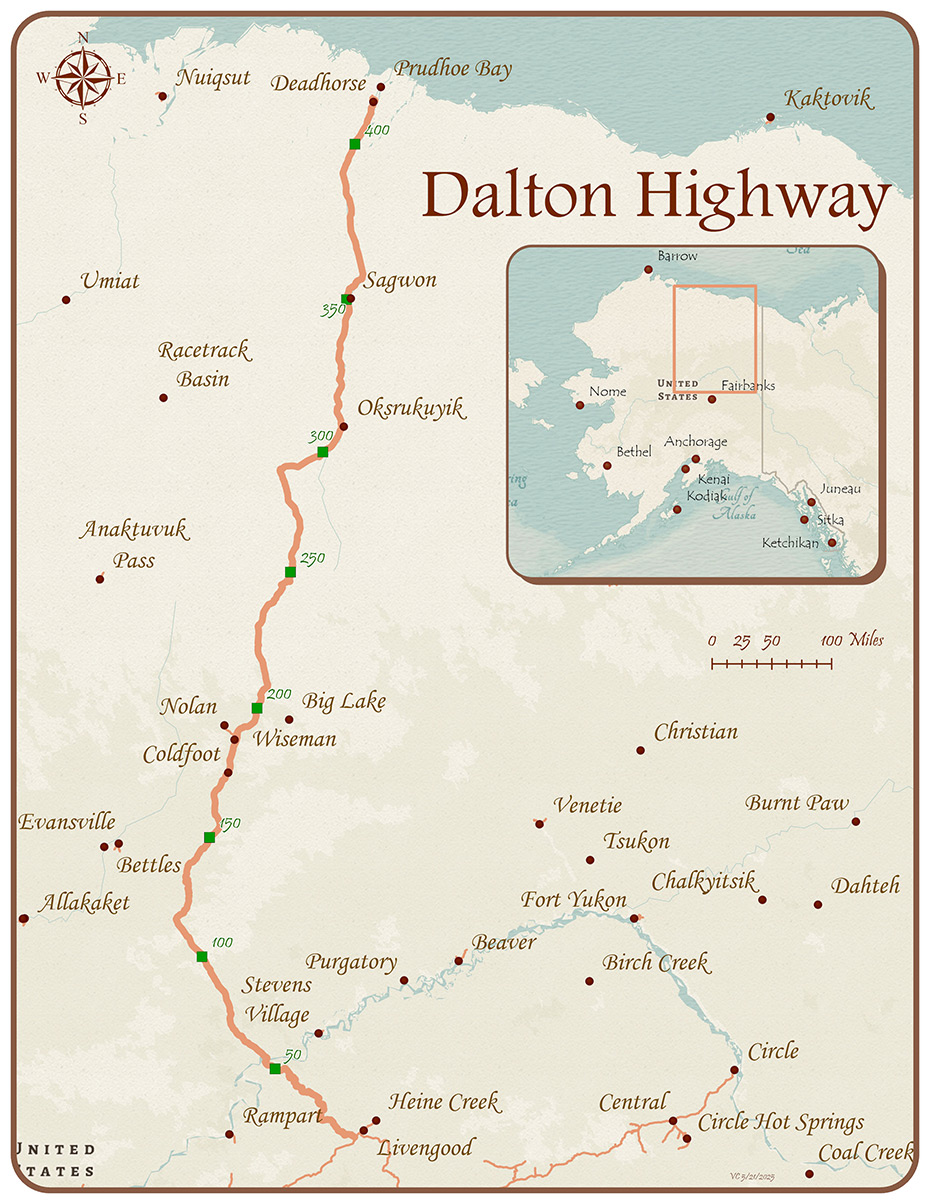
The Dalton Highway stretches 414 miles from Livengood, located about 80 miles north of Fairbanks, to Deadhorse on Alaska's Arctic coast.
Along the way, the highway passes through some of Alaska's most diverse and remote landscapes. The route begins in the boreal forest, climbs over 4,800-foot Atigun Pass in the Brooks Range, descends through the Arctic Foothills, and ends across approximately 55 miles of Arctic coastal plain tundra.
The Dalton Highway serves as a vital transportation corridor for Alaska's North Slope. Most traffic consists of commercial trucks hauling fuel, equipment, and supplies to support oil field operations. Since the highway opened to the public in 1994, it has also become an increasingly popular destination for travelers, including motorists, motorcyclists, cyclists, and other adventurers seeking a unique Arctic experience.
Drivers can expect mostly gravel and dirt surfaces, with intermittent sections of pavement. Road conditions can be rough in both summer and winter, making it essential to travel in a vehicle that is properly equipped for remote conditions.
Planning a Trip on the Dalton Highway?
If you're planning to drive a rental vehicle, check your rental agreement before heading north. Many rental car companies prohibit travel on the Dalton Highway or do not cover damage incurred on the road.
The first thing to know about the Dalton Highway is that it is not your average highway! If you're planning to drive it, be prepared for challenging conditions year-round and extremely limited services.
Traveling the Dalton requires a reliable vehicle capable of handling rough road conditions, along with extra fuel, food, water, first aid supplies, spare tires, warm clothing, and other emergency equipment. Guided tours are also available and offer a safe, convenient way to experience this iconic route.
Most traffic on the Dalton consists of commercial vehicles traveling to and from Alaska's North Slope, delivering fuel, equipment, and supplies that support oil field operations. Be prepared to share the road with large trucks and drive cautiously.
Before heading to the Arctic Circle or Deadhorse, check current road conditions for the Dalton Highway and other routes across Alaska via Alaska 511.
Traveling in Winter?
Winter travel on the Dalton Highway requires careful planning and preparation. Winter conditions can begin as early as August and persist through June, and snowfall has even been recorded in July.
Severe weather can create hazardous driving conditions, particularly in Atigun Pass, where avalanches can temporarily close the highway and leave travelers stranded for days. Heavy snowdrifts can become impassable, even for large commercial trucks.
Many drivers rely on CB radios to communicate road conditions, making one a valuable addition to your vehicle during winter travel.
The Dalton Highway is a remarkable destination, but it demands respect. Plan ahead, travel prepared, and make safety your top priority.
Maintenance and Road Conditions
The Alaska Department of Transportation and Public Facilities (DOT&PF) operates seven year-round maintenance camps along the Dalton Highway corridor. Crews work 6 a.m. to 6:30 p.m. and operate on a two-weeks-on, two-weeks-off schedule to maintain this remote route throughout the year.
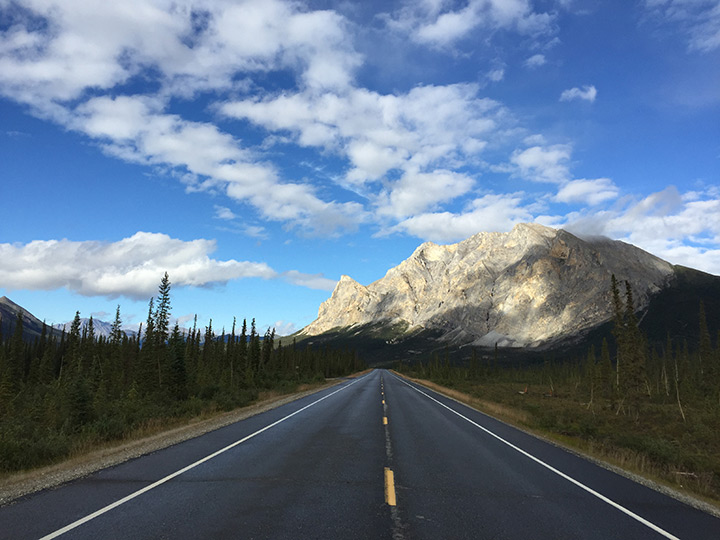
View of Mount Sukakpak, 28.5 miles north of Coldfoot on the Dalton Highway. Photo by Jake Allen, Alaska DOT&PF
Each maintenance station is responsible for approximately 60 to 70 miles of roadway, helping keep the Dalton Highway open and maintained through changing conditions.
For more detailed maintenance information, visit our Dalton Highway Maintenance page. To learn about current and upcoming construction projects focused on improving safety and roadway conditions, visit our Construction on the Dalton Highway page.
Construction of the Dalton Highway
As development of Alaska’s North Slope oil fields moved forward, oil companies needed reliable access to facilities in Deadhorse and a way to support maintenance of the Trans-Alaska Pipeline. In 1969, Alyeska Pipeline Service Company began constructing the first version of the Dalton Highway, then known simply as the Haul Road, beginning with the section from Livengood to the Yukon River.
The road was originally built to support private oil industry operations, although Alyeska agreed to construct it to state secondary-road design standards. Progress on the pipeline and road was delayed by the settlement of Alaska Native land claims through the Alaska Native Claims Settlement Act of 1971 and legal challenges over pipeline permits and environmental reviews.
Following passage of the Alaska Pipeline Authorization Act in 1973, construction moved forward. In 1974, Alyeska completed the majority of the Haul Road, building approximately 390 miles of roadway in just five months to support construction of the Trans-Alaska Pipeline.
Dalton Highway History
The first road built for motorized vehicles across Alaska’s Arctic landscape was the Hickel Highway. Opened in 1968, it was the first attempt to provide road access to the newly discovered oil resources on the North Slope.
The road played an important role in the early development of the Prudhoe Bay oil fields, allowing the first supplies to be delivered and supporting construction of the initial permanent facilities. However, the route was located farther west than the alignment selected for the Trans-Alaska Pipeline. Maintenance was discontinued and the Hickel Highway was eventually abandoned.
From Haul Road to Dalton Highway
For several years during construction of the Trans-Alaska Pipeline, the Haul Road was a hub of constant activity. Thousands of workers, contractors, and truck drivers traveled the route, hauling materials and supplies to pipeline construction camps across the North Slope.
The work was demanding, and the road presented significant challenges. Harsh weather, difficult terrain, and rough conditions, especially through the Brooks Range, made travel dangerous. Many drivers, including those new to Alaska’s unique driving conditions, quickly learned that the Haul Road required skill, preparation, and respect.
Alyeska completed the Trans-Alaska Pipeline in 1977, and oil began flowing from Prudhoe Bay to Valdez on June 20 of that year. While the Haul Road remained an important route for pipeline maintenance and transportation, Alyeska no longer needed to operate it directly.
In 1979, Alyeska transferred the road to the State of Alaska, which opened it to public traffic in phases. The road was officially named the James W. Dalton Highway in honor of an Alaskan engineer and pioneer who played a key role in Arctic development. In 1994, the entire highway opened to the public, providing travelers access to one of Alaska’s most remote and iconic routes.
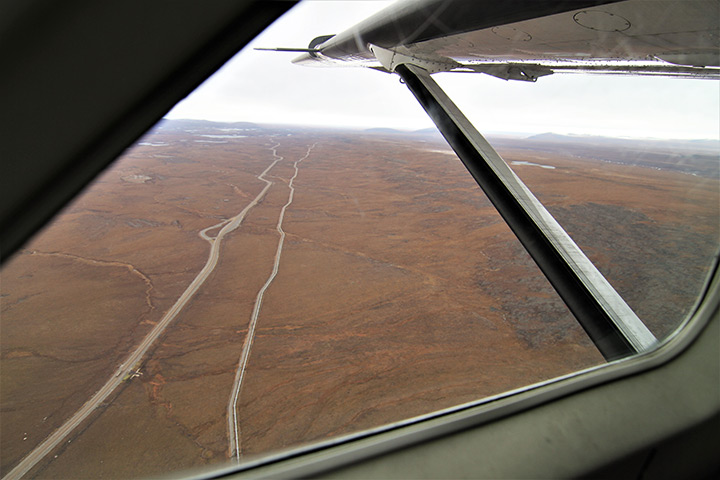
From the passenger seat of a small commuter plane, the Dalton Highway and the Trans Alaska Pipeline are seen running side-by-side north of Atigun Pass. Photo by Caitlin Frye, Alaska DOT&PF
Dalton Highway Historical Resources
The following historical resources about the road that became the Dalton Highway are from Historic Roads of Alaska: Driving the History of the Last Frontier, published in 2017 by the Alaska Department of Transportation and Public Facilities and other state agencies with funding from the Federal Highway Administration.
To learn more about the history of the Dalton Highway and other historic routes across Alaska:
- Download a PDF copy of the full booklet here.
- Visit Alyeska Pipeline Service Company’s Dalton Highway website.
- Visit the University of Alaska Fairbanks Haul Road website.
- Additional first-person accounts and stories about the Dalton Highway are available through the Project Jukebox Oral History Program at the University of Alaska Fairbanks.