

Frequently Asked Questions

What is the Seward to Glenn Connection PEL Study?
The Alaska Department of Transportation and Public Facilities (DOT&PF), Central Region, conducted a Planning and Environmental Linkages (PEL) Study to consider potential transportation improvements in Anchorage, with the intent to improve:
- Safety
- Livability
- Regional travel between the Seward and Glenn Highways
- Local travel within the surrounding neighborhoods
- Freight connection between the Port and the Seward and Glenn Highways.
The PEL Study process gave DOT&PF an opportunity to engage the community and stakeholders in identifying transportation and community needs, developed potential solutions, and narrowed down the list of alternatives that could be carried into future environmental review and design processes.
Who conducted and funded the study?
DOT&PF managed the study in cooperation with Anchorage Metropolitan Area Transportation Solutions (AMATS). AMATS is the Metropolitan Planning Organization responsible for transportation planning for the Anchorage Bowl and Chugiak-Eagle River areas. Funding for the study was provided by the Federal Highway Administration through AMATS.
What were the study area limits?
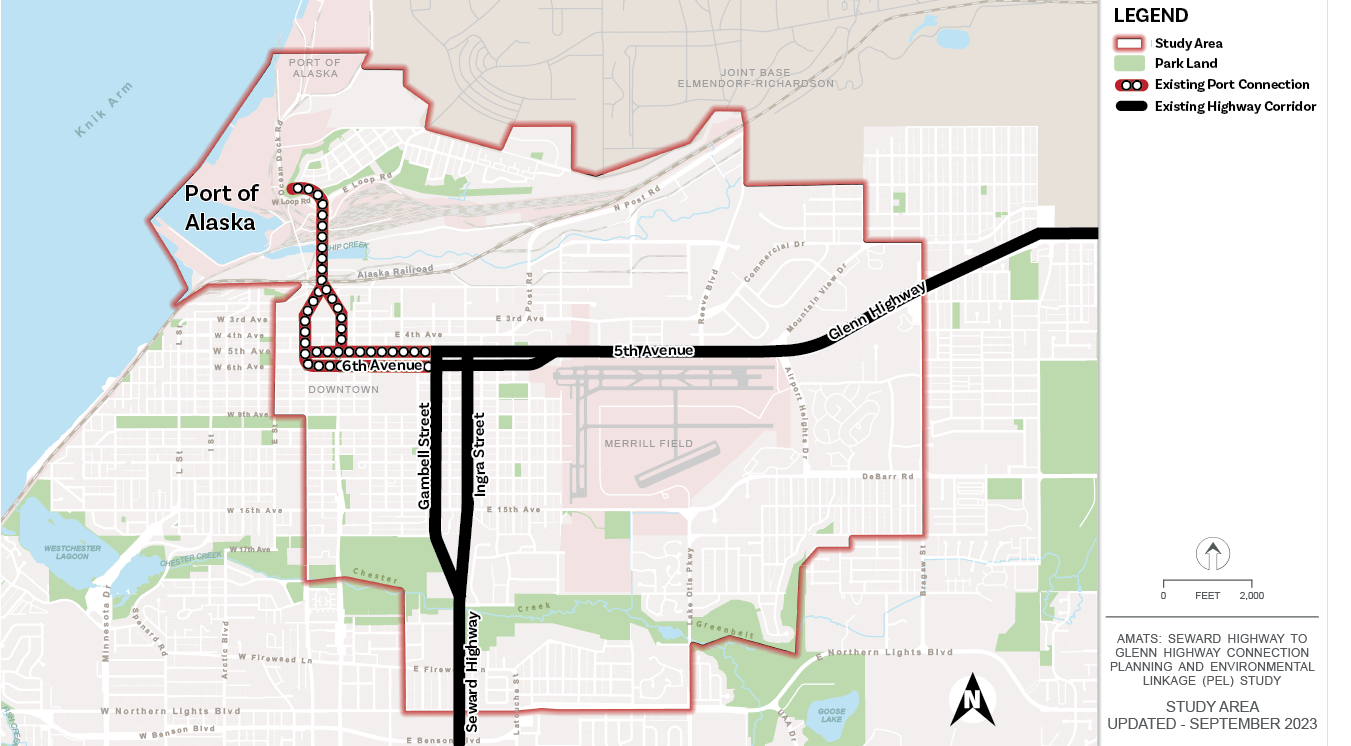
The study area boundary generally followed Bragaw Street on the east, Northern Lights on the south, C Street on the west, and Joint Base Elmendorf-Richardson on the north. It included areas where potential transportation improvements could be developed between the Glenn and Seward Highways and to and from the Port of Alaska. The study area was broad enough to also gauge how nearby community councils and traffic levels on parallel routes may be affected.
Figure 1: General Study Area
What is a Planning and Environmental Linkages (PEL) Study?
According to the Federal Highway Administration (FHWA), a PEL Study represents a collaborative and integrated approach to transportation decision-making that (1) considers environmental, community, and economic goals early in the transportation planning process and (2) uses the information, analysis, and products developed during planning to inform the environmental review process. See more at Planning and Environment Linkages | Environmental Initiatives | Environmental Review Toolkit | FHWA (dot.gov). Learn more about the PEL Study process in this downloadable handout.
What are the potential benefits of a PEL Study?
The PEL process aids the transportation decision-making process. The PEL Study:
- Identified potential benefits and impacts to communities, the environment, and the economy early in the planning stage, making future design projects more efficient and cost-effective.
- Engaged partner agencies, stakeholders, and the public, building study awareness and support through transparent and consistent communication.
- Provided opportunities early and often for the public to provide input that shaped the study outcomes.
- Narrowed down the range of project alternatives to carry into future environmental review, design work, and construction project phases.
What was the PEL Study schedule?
The PEL Study process began in June 2021 and was completed in August 2026 (see Figure 2). The dates shown in the original schedule graphic below may not reflect the actual dates. After completing the final PEL Study, projects can move into additional environmental review and design through the National Environmental Policy Act (NEPA) process. Funding for construction projects will need to be included in the Alaska Statewide Transportation Improvement Program (STIP) and AMATS Transportation Improvement Plan (TIP) if projects identified in the PEL are to advance into NEPA, design, right-of-way acquisition (i.e., purchasing private property if needed), and construction.
Figure 2: Project Schedule

What is the study’s background?
Connecting the Seward Highway to the Glenn Highway was discussed as early as 1972 in the Anchorage Long Range Transportation Plan (LRTP).
In 2001, AMATS conducted the East Anchorage Study of Transportation. It was determined that connecting the Seward and Glenn Highways was important to solving traffic congestion in the Anchorage Bowl.
In 2005, the “Highway to Highway” (H2H) project was adopted as part of the Anchorage Bowl 2025 LRTP. DOT&PF started an Environmental Impact Statement (EIS) process for the H2H project, but the EIS was canceled in 2010 by the Governor.
In 2020, DOT&PF, in partnership with community organizations (i.e., Fairview Community Council), recognized the continuing need to address transportation issues in this corridor. DOT&PF then included the PEL Study as part of the AMATS Metropolitan Transportation Plan (MTP) 2040.
What prompted the PEL study?
The existing connection between the Seward and Glenn Highways on the Ingra-Gambell couplet through Fairview causes major safety and livability issues in a predominantly ethnic and lower income neighborhood. It is also notable that Fairview has a much higher percentage of residents without vehicles than most neighborhoods in Anchorage, making it more challenging for those users to cross roughly 40,000 vehicles per day on the Glenn Highway to access basic services, such as groceries, the post office, churches, schools, parks, employment, etc. For these reasons, the Fairview Community Council requested AMATS provide funding to complete a freeway connection study.
When the PEL Study began, it was identified in the previously adopted Anchorage Metropolitan Transportation Plan (MTP), 2040. That plan indicated that the study should “define a vision for the future of this connection, identify environmental and resource concerns and opportunities in the study area, and use the information to develop reasonable alternatives through consultation with the affected agencies and the public.” This PEL Study is officially titled the Seward Highway to Glenn Highway Planning and Environmental Linkages Study (IRIS Program No. CFHWY00550 | Federal Project No. 0001653).
What was different about this study?
DOT&PF conducted this PEL Study as a re-examination of a long-standing project in the Anchorage MTP 2040 that called for connecting the Seward and Glenn Highways through Anchorage and included a project (MTP project #214) with the following description: “Construct freeway connection between Seward Highway/20th Avenue and 13th Avenue with freeway access and egress ramps onto Ingra/Gambell Streets near the northern termini of the project. Reconstruct Ingra Street/Gambell Street and construct separated grade crossings of the freeway to reconnect portions of the east-west street system. Construct an interchange at Airport Heights Drive and Glenn Highway Intersection.” The Seward to Glenn Connection PEL Study went beyond a strict examination of a “freeway connection” and considered a broad scope of ideas, including:
- Re-examining anticipated traffic levels to determine if a “freeway” is still the right facility type. In fact, data along with public feedback led the project team to move away from a freeway solution. The roadway connections were revised to include reduced number of lanes and slower speeds, with the continued intent to remove regional and port traffic from neighborhood streets.
- Identifying potential access improvements to and from the Port of Alaska.
- Considering community and neighborhood viewpoints in identifying problems and potential solutions.
- Advancing the PEL Study by taking a fresh look at the transportation needs and community goals, objectives, and visions in plans adopted since the last time this project was studied.
What’s changed in the area since highway mobility needs and solutions were last studied?
When the study area was last examined in detail, the Knik Arm Crossing project and a viaduct (long bridge) over the ship creek industrial area connecting Gambell/Ingra to the Port of Alaska were still part of the adopted Metropolitan Transportation Plan (MTP). Since then, economic conditions are vastly different, and growth and land use development patterns are now subject to a newly adopted land use plan map. For these reasons, traffic patterns and congestion levels are different from those studied in 2010. It was important to re-examine the transportation needs in light of these and other changes to be certain the proposed improvements address the existing needs.
What problems did the study examine?
The study addressed the following related to the connection between the Seward and Glenn Highways:
- Safety (most notably for non-motorized users)
- Livability
- Regional travel between the Seward and Glenn Highways (Interstate Highway System, IHS)
- Local travel within the surrounding neighborhoods
- Access between the IHS and Port of Alaska
To improve livability and local travel within the surrounding neighborhoods, the project team:
- Established effective communications management protocols for a solid project foundation
- Identified problems to be solved based on updated data and public input.
- Developed a Purpose and Need Statement and evaluation criteria based on issues identified through data analysis and public/stakeholder outreach.
- Developed alternative concepts and reviewed them for fundamental flaws and practicality.
- Refined and further developed reasonable alternatives to reduce neighborhood and environmental resource impacts resulting from vehicle noise, residential and business relocations, cut-through traffic, and congestion.
Based on feedback on the refined alternatives and additional data gathering, the team arrived at a recommended alternative (sub-area plan) for various roadway and active transportation improvement projects in the study area.
The recommended alternative will address the identified problems based on engineering and environmental analyses. As a PEL Study, the efforts integrated community and environmental factors into the decision-making process, with a strong emphasis on public involvement.
How will the study be used?
Now that the final PEL Study is complete, multiple projects or components of the overall plan can move forward for additional environmental review and engineering design through the NEPA process. The results of the study can feed into future MTPs, potentially updating needed improvements, cost estimates, and the timing and phasing of improvements. Each project’s funding will need to be included in the STIP and TIP for recommended projects identified by the PEL to advance into NEPA, design, right-of-way acquisition, and construction.
How did the project team engage stakeholders and the public during the PEL process?
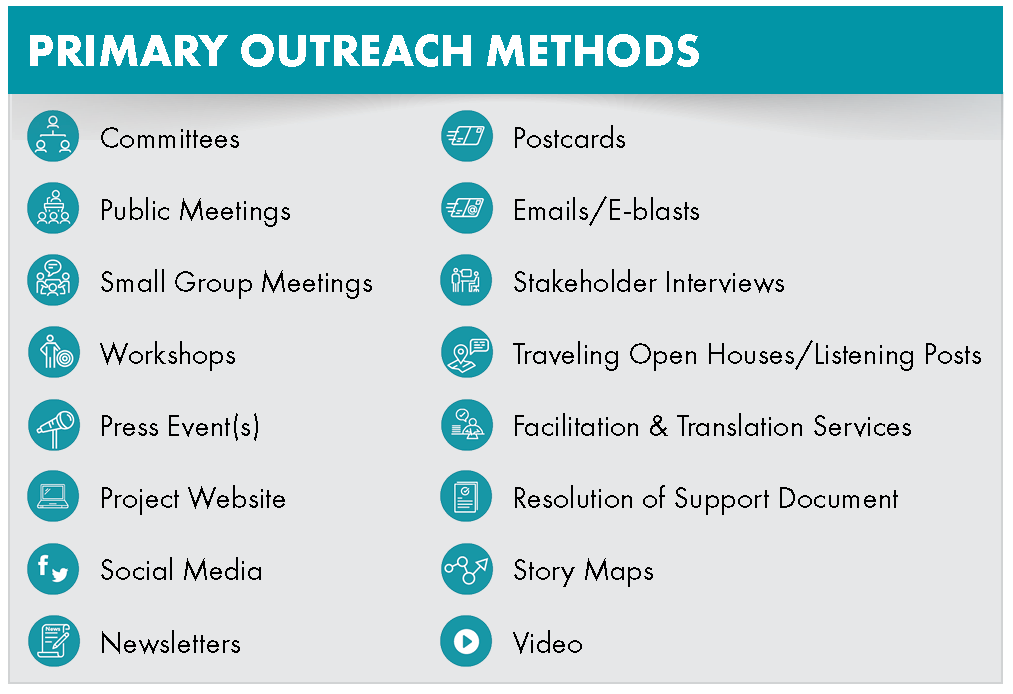
The PEL Study process included robust opportunities for feedback from the community and stakeholders, and that feedback was central to the development of design alternatives. The project team provided opportunities at each stage for the public to learn about the study and provide input. See the image below for the primary outreach methods being utilized.
Figure 3. Primary Outreach Methods
Through the entire process, the team engaged individuals and key groups of stakeholders to help inform the study, develop and screen alternatives, and review the Draft PEL Study Report. This included agencies, Tribes, elected officials, utilities, emergency responders, businesses, nonprofits, community organizations (e.g., Alaska Trucking Association, Bike Anchorage, Anchorage Senior Activity Center, Faith organizations, etc.), and the public. A Technical Advisory Committee, Community Advisory Committee, Agencies and Tribes Committee, and Executive Committee were established specifically for the Seward to Glenn Connection PEL and provided input to the study team at major milestones.
DOT&PF was committed to conducting a process that was equitable and responsive to the needs of traditionally underserved communities. This means:
- Providing accessible, inclusive, and convenient opportunities to engage.
- Reaching out to and integrating feedback from individuals and groups that are traditionally underserved, underrepresented, and disproportionately burdened/impacted by existing transportation systems.
- Communicating with the public regarding the feedback we received.
How did the Study team collaborate with the Fairview neighborhood?
In 2023, the Fairview community was awarded a Reconnecting Communities Pilot Program (RCP) Grant from the U.S. Department of Transportation (USDOT). This grant focuses on improving access to daily needs, fostering equitable development, and restoration, and USDOT provided technical assistance.
The PEL Study team met monthly with the Fairview RCP grant committee to align the PEL Study with the Reconnecting Fairview community-led initiative.
Will traffic avoid Ingra and Gambell if they lose lanes and become Main Streets?
Traffic models show traffic diversion increases as more lanes are removed from the National Highway System and Interstate Highway System (i.e., 5th Ave, 6th Ave, Ingra St, and Gambell St). The model shows traffic bypassing the Ingra-Gambell Couplet by using roads to the southeast of Fairview, such as Airport Heights Dr, Debarr Rd, 15th Ave, Bragaw St, Lake Otis Pkwy, and Northern Lights Blvd. The model also shows traffic bypassing 5th Ave along Merrill Field by using 3rd Avenue and C and A Streets.
Due to these traffic diversion patterns shown in the model, increases to daily vehicle trips on these roadways are predicted to occur. The team analyzed the existing and, in some cases, proposed capacities on these roadways to see if the vehicle diversion may cause new, or increased, congestion and/or safety issues on these roadways and in these neighborhoods.