

DOT&PF Process Brief:
What Every Leader Needs to Know About
Project Construction
Overview/Historical Information
Alaska DOT&PF’s construction program includes Highways, Airports, Marine Highways, and Public Facilities. The construction effort includes:
- Preventive Maintenance – work intended to preserve or extend the service life of an existing facility, that does not otherwise significantly alter the appearance, capacity, or function of the facility,
- Resurfacing/Restoration/Rehabilitation – work intended to extend the service life, enhance safety, and make minor functional enhancement to the facility. Depending on the condition of the existing facility, the safety history of the facility, and on the functional classification of highway facilities, this work does not necessarily require upgrading all elements to satisfy current design criteria,
- Reconstruction – work that retains much of original facility features while enhancing the original investment to improve safety, improve capacity, and meet current design criteria.
- New Construction – new facilities constructed to meet current design criteria while addressing functional demands including growth, safety, ongoing maintenance and operations, etc., throughout the anticipated design life of the facility.
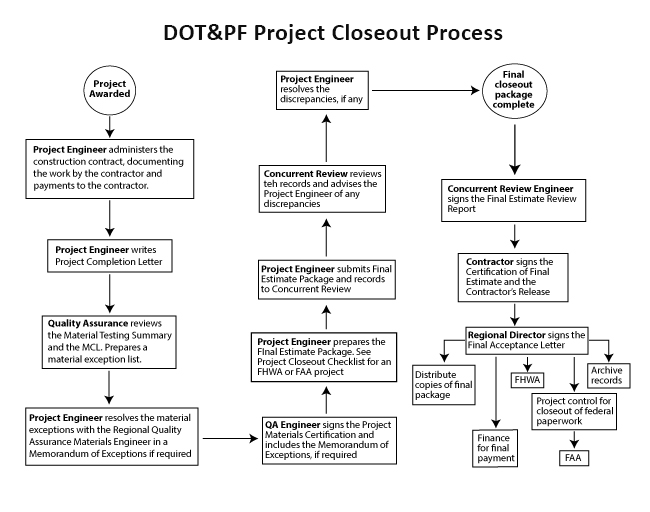
Process Description/Infographic
Most of Alaska DOT&PF’s construction activities are performed by contractors, suppliers, or third-party vendors. However, certain preventive maintenance activities are performed directly by DOT&PF staff. The in-house construction work performed by DOT&PF staff is limited to ongoing maintenance & operations, and minor preventive maintenance activities.
The majority of Alaska DOT&PF’s construction program is accomplished with federal-aid funding. With few exceptions, the federal funding requires a state funding match in order for the individual projects to be eligible for federal-aid funding.
Alaska’s Highway and Marine Highway construction programs typically receive federal-aid from Federal Highway Administration (FHWA) and Federal Transit Authority (FTA). Our Airports construction program typically receive federal-aid from the Federal Aviation Administration (FAA) grants. And our Public Facilities (vertical construction) construction program typically receives federal-aid from FHWA, FTA, or FAA, or from a combination of the federal sources.
In order to receive federal-aid funding for Alaska’s construction program, the State of Alaska is required to have resources in place to maintain the investments throughout their design life. Additionally, the federal-aid construction program is required to have processes and procedures in place to administer the program in accordance with applicable federal, state, and local laws and regulations, and to assure the materials and construction meet predetermined performance, quality, safety, and environmental standards. The federal-aid programs require quality assurance practices which include individual project and program approval steps, and minimum testing frequencies for material acceptance and for independent (separate from testing) assurance testing to validate the testing and processes used for material acceptance. Accepting and assurance testing is performed using nationally accredited lab and testing facilities, by nationally accredited technicians.
All Alaska DOT&PF Construction Program activities requiring any federal action (permitting, approval, federal-aid, etc.) are required to comply with the National Environmental Policy Act (NEPA). In order to advance to construction, NEPA requires approval of the appropriate environmental document by the lead federal agency. If the federal action requires permitting, approval, or funding from more than one agency, the lead agency requires coordination with all affected or participating federal agencies.
Terms to Know:
- AASHTO – American Association of Highway and Transportation Officials (AASHTO is the basis for Alaska’s highway design standards)
- NEPA – National Environmental Policy Act
- 23 CFR – Title 23 of the Code of Federal Regulations. Title 23 represents the federal regulations for the National Highway Safety Administration and the Federal Highway Administration.
- 40 CFR – Title 40 of the Code of Federal Regulations. Title 40 represents the federal regulations for the Protection of the Environment and the regulations issued by the Council on Environmental Quality.
- 49 CFR, Part 24 – Uniform Relocation Assistance and Real Property Acquisition for Federal and Federally Assisted Programs. Part 24 represent the federal requirements governing the department’s process and procedures for acquiring rights of way necessary for public facilities and the public’s transportation system.
- AIP – Airport Improvement Program. The AIP is the grant program administered by the Federal Aviation Administration (FAA) to fund airport development projects.
Standards
 |
D&C Standards Home |
 Staff Staff |
|
| Related Resources |
|
|
Construction |
|
ePermits |
|
Preconstruction |
|
Standard Specifications |
|
Right-of-Way |
|
Traffic & Safety |
|
Publications |
|
Site Questions & Comments |
|
Contact D&ES Webmaster |
3132 Channel Dr.,
P.O. Box 112500 Juneau, AK 99811-2500 Phone: (907)465-4225 |
|
Lauren Little, P.E. |
|