

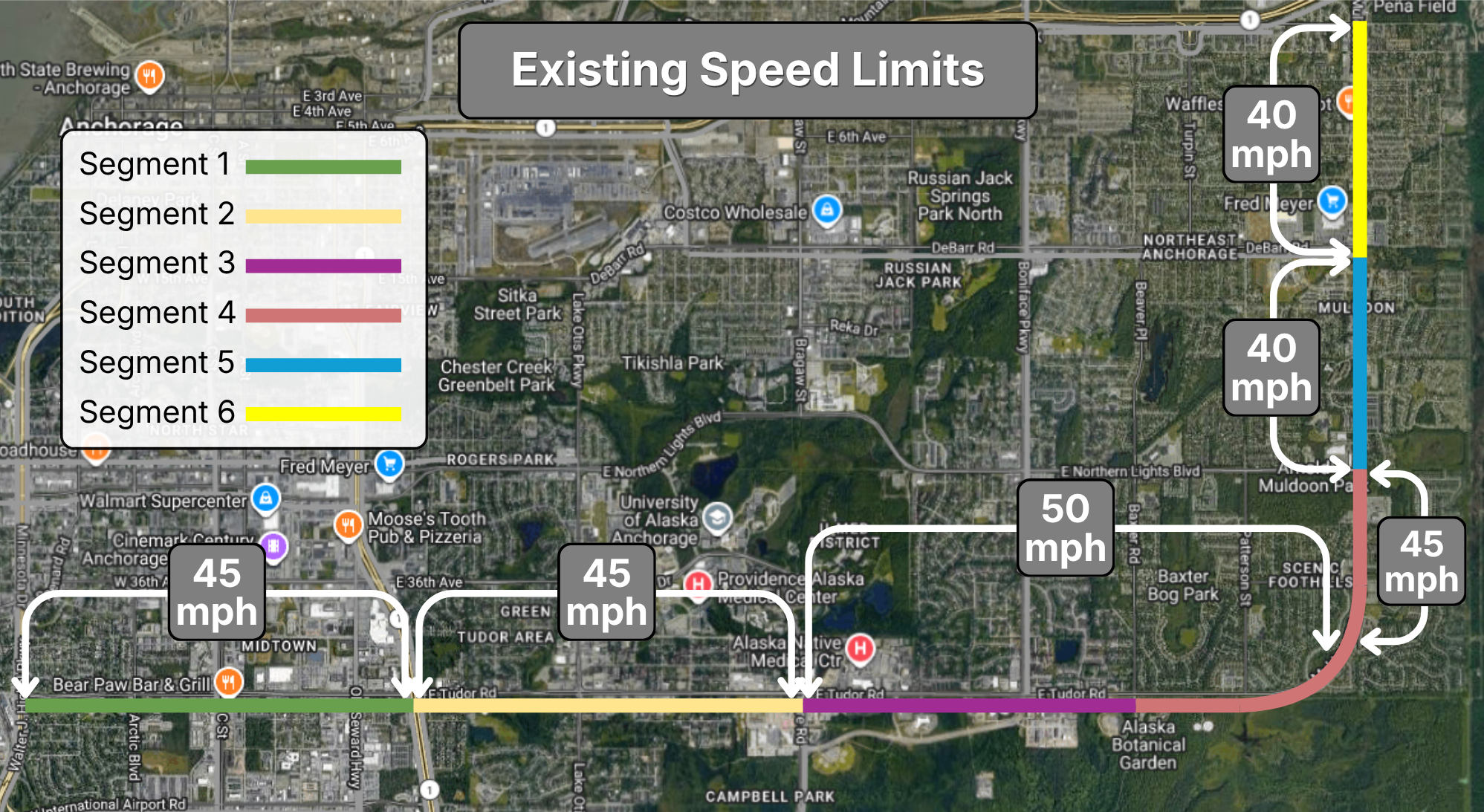
The Alaska Department of Transportation & Public Facilities (DOT&PF) is evaluating the speed limits on Tudor Road and Muldoon Road between Minnesota Drive and Boundary Avenue. The current speed limit along this corridor varies from 40 MPH to 50 MPH.
Do you travel on the Tudor/Muldoon corridor? We want to hear what you think about the current speed limits.
Here’s how you can provide comments:
This corridor has a higher-than-average crash rate, including a high number of pedestrian-involved crashes. DOT&PF analyzed crashes between January 2020 and December 2024. During this period there were 2,224 crashes on Tudor and Muldoon Roads, including 42 serious injury crashes and 10 fatal crashes. Of the ten fatalities, six were pedestrians and one was a bicyclist. Of the 42 serious injury crashes, 11 involved a pedestrian and 3 involved a bicyclist. After the end of that study period, through December 2025, there were two additional pedestrian deaths along the corridor.
In response to elevated fatal pedestrian crashes across Anchorage, many community members and leaders have called on DOT&PF to take action to reverse this trend, including specific requests to lower speed limits.
The Anchorage Assembly passed a resolution in October 2024 calling on the Municipality of Anchorage and DOT&PF to “take action in response to pedestrian deaths” including “[l]owering speed limits by at least 10 miles per hour, not to exceed 35 miles per hour, on corridors where fatalities have occurred.”
In November 2024 the Spenard Community Council passed a resolution urging DOT&PF and the Municipality of Anchorage to “Reduce speed limits without delay by 10 mph on corridors identified in the Vision Zero “high injury network,” AMATS Safety Plan, and the Strategic Highway Safety Plan/Vulnerable Road User Plan.”
The Campbell Park Community Council passed a June 2025 resolution requesting DOT&PF “reduce the speed limit from 45 miles per hour to 35 miles per hour on East Tudor Road between Lake Otis Parkway and Elmore Road, and to 40 miles per hour on other portions of Tudor Road[.]”
In September 2025 the Fairview Community Council passed a resolution supporting efforts to “Reduce speed limits on key roadways to ensure all users of the right-of-way are safe[.]” The Vision Zero Task Force, a working group made up of representatives from DOT&PF, the Municipality of Anchorage, the Anchorage Police Department, AMATS, and others, identified this corridor as the top priority for a speed limit evaluation due to the high number of pedestrian deaths.
The Vision Zero Task Force has presented at 22 community council meetings across Anchorage since November 2024. All the presentations emphasized the Tudor/Muldoon corridor as the top priority for a speed reduction evaluation.
DOT&PF may begin an evaluation of a posted speed limit after receiving formal requests from community members that show support for a speed limit change. Speed limit changes may also be considered when a road is redesigned.
In the case of the Tudor/Muldoon corridor, the evaluation was motivated by the October 2024 resolution passed by the Anchorage Assembly requesting speed limit reductions across Anchorage, and a subsequent analysis of high crash corridors by the Vision Zero Task Force. This prompted DOT&PF to initiate a speed study—an engineering and traffic investigation that considers a variety of factors to determine an appropriate speed limit.
According to Alaska Statute (AS 19.10.072), DOT&PF must consider the following factors in priority order when evaluating speed limits: 1) neighborhood safety including the presence of children and pedestrians; 2) the presence of schools, houses, parks, and crosswalks; 3) the presence of driveways, parked vehicles, and turn locations; 4) the speed at which safe and prudent drivers travel; and 5) the effectiveness of local enforcement in the corridor. DOT&PF is also required to consult with local government and community members.
As part of this analysis, DOT&PF traffic safety staff spent time in the corridor observing the types of users present, conducting multiple drive-throughs to determine safe and prudent speeds, and measuring the speeds of other drivers. They also reviewed crash data, counted driveways and turn locations, and analyzed aggregated speed data from connected vehicles.
A few highlights:
Reducing the speed limit alone will have a limited effect on driver speed. For speeds to be effectively reduced, the data show that other efforts should accompany a lower speed limit, including engineering changes that alter the character of the road, increased enforcement of posted speeds, and educational campaigns Because the speed data that has been collected does not support a reduction to 35 MPH under DOT&PF policy and procedures, and state and federal guidelines, a public hearing is needed to gather public input regarding a potential speed limit reduction.
More information about how DOT&PF sets speed limits is available at How Are Speed Limits Set?.
DOT&PF and the Vision Zero Task Force are hosting a public hearing to listen to community members’ feedback on a lower speed limit and how it may change their use of the corridor.
TUDOR & MULDOON ROADS SPEED LIMIT PUBLIC HEARING
When: Wednesday, June 10, 2026 from 5:30 – 8:00 p.m.
Where: Loussac Library, Wilda Marston Theater, 3600 A Street, Anchorage
This will be a formal public hearing It will begin with a short presentation, followed by a formal public comment period in which members of the public are invited to speak and their testimony is entered into the record. Members of the public may also submit written comments, and chose whether they would like those comments verbally entered into the record as well.
Members of the public will each received three minutes and will be called in order of signing up. You will be asked to identify yourself by your full name and the street or neighborhood in which you reside. While there is a short presentation at the beginning of the hearing, the hearing is designed to allow the public time to be heard. Questions will be answered if time allows, and a comprehensive question and answer document will be posted on this website after the meeting.
If you would like your written comment to be entered into the record at the hearing, please email them to dot.besafe@alaska.gov. Please keep your written comments to 450 words (only the first 450 words will be read aloud and entered into the formal record). Include your full name and the street or neighborhood where you live.
Please contact us at dot.besafe@alaska.gov or 907-269-6323 if you have questions or to request accommodations for the public hearing. Please make your accommodation requests as soon as possible or at least one week before the hearing.
DOT&PF will compile the feedback collected during the public hearing and share it on this website. Feedback will help DOT&PF understand how much public support there is for a speed limit reduction, and how a reduced speed limit may influence driver behavior. This information will be considered, along with data collected during the speed study, to help DOT&PF make a recommendation about whether the speed limit should be reduced and what other mitigation measures, if any, may be needed (like public information campaigns, engineered safety improvements, or increased enforcement).
According to a report published by the Federal Highway Administration that looked at driver behavior and crash data from 100 sites in 22 states where speed limits had been lowered or raised, changing speed limits alone had little effect on how fast people drive. One of the conclusions of the report states, “Changing speed limits alone, without additional enforcement, educational programs, or other engineering measures, has only a minor effect on driver behavior.”
The data shows that 85% of drivers are driving at speeds near or above the speed limit on Tudor and Muldoon Roads. This indicates that reducing the posted speed limit alone will have a limited effect on how fast people drive. For a speed reduction to be effective, DOT&PF and the Municipality of Anchorage will need to consider additional interventions like engineered changes (for example, narrower lanes), increased enforcement, and educational campaigns.
The following table shows the results of data collection performed by DOT&PF staff in the summer during low volume hours under fair weather conditions. The 85th percentile and 50th percentile speeds show the speed at which 85% and 50% of the vehicles were traveling at or below. The pace is the 10 mile per hour range that includes the largest number of vehicles, and the median pace is the middle of that range.
| TUDOR ROAD | TUDOR & MULDOON ROADS | MULDOON ROAD | |||||
| Minnesota Dr to New Seward Hwy | New Seward Hwy to Elmore Rd | Elmore Rd to Baxter Rd | Baxter Rd to E Northern Lights Pkwy | E Northern Lights Pkwy to DeBarr Rd | DeBarr Rd to Boundary Ave | ||
| (Segment 1) | (Segment 2) | (Segment 3) | (Segment 4) | (Segment 5) | (Segment 6) | ||
Speed (mph) |
Posted Speed | 45 | 45 | 50 | 50-45 | 40 | 40 |
| 85th Percentile | 47 | 44 | 51 | 54 | 42 | 42 | |
| 50th Percentile | 42 | 41 | 47 | 50 | 38 | 37 | |
| Pace Range | 39-48 | 36-45 | 44-53 | 46-55 | 35-44 | 33-42 | |
| Pace Median | 43 | 41 | 49 | 50 | 39 | 38 | |
| Observations | 669 | 679 | 213 | 445 | 462 | 704 | |
Please contact us at dot.besafe@alaska.gov or 907-269-6323.
DOT&PF operates Federal Programs without regard to race, color, national origin, sex, age, or disability. Full Title VI Nondiscrimination Policy: dot.alaska.gov/tvi_statement.shtml. To file a complaint, go to: dot.alaska.gov/cvlrts/titlevi.shtml. DOT&PF complies with Title II of the Americans with Disabilities Act of 1990. Individuals with disabilities who may need auxiliary aids, services, and/or special modifications to participate in this public hearing should contact 907-269-6323, or TDD number 711. Requests should be made at least 5 days before the accommodation is needed to make any necessary arrangements.