Functional classification is a way of categorizing public roads based on how they are currently used, or what function they currently serve in the context of the larger road network. Functional classifications are intended to reflect how people are moving through the road network, or the function that any given route currently serves.
Alaska DOT&PF is responsible for making sure all public roads in the state, regardless of who owns them, are properly classified using guidance from the federal government and input from communities, tribes, and other agencies. We are required to review statewide functional classifications every ten years. Reference 23 CFR 470.105 for more information.
Alaska DOT&PF completed the most recent decennial statewide review on 12/31/2025, and it was approved by the Federal Highway Administration (FHWA). Click the following link to read more about the project: Functional Class Project StoryMap.
For the Statewide Functional Classification Update Final Report click here 6MB.
Which roads are included?
All public roads are reviewed. A public road is defined as any road that is under the jurisdiction of and maintained by a public entity and is open to public travel. Roads are considered open for public travel if they are passable by a standard passenger car, not blocked with gates or prohibitive signs, and are open with exception of seasonal closures, extreme weather, or other emergencies.
Boardwalks and ice roads are not considered public roads for the purposes of functional classification. Likewise, pedestrian facilities like separated paths, sidewalks, and trails are not assigned functional classifications.
Functional classification categories
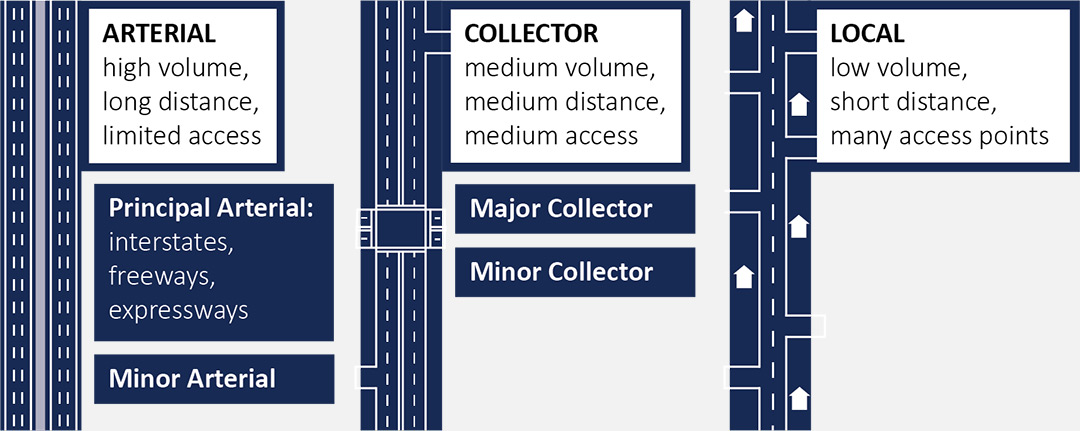
The three main functional classification categories are:
Within each of these categories are additional sub-categories.
Why does Functional Classification matter?
The functional classification of a road can determine management and maintenance priorities, project funding eligibility, and how roads are designed. For example, roads that primarily move travelers long distances like interstates and principals arterials will have different design standards for how wide the lanes are, how sharp the curves are, and what the speed limit should be than neighborhood roads that primarily serve residential areas.
How do you decide how roads are classified?
FHWA has provided guidance for how roads should be classified based on their function. Following that guidance, we developed Alaska-specific criteria. These Alaska-specific criteria have been reviewed by the FHWA.
Interstates, which is a subcategory under the arterial classification, are designated through a separate process through the FHWA, so those designations will not change. Alaska's interstates include the Richardson, Parks, Glenn, and Tok Cutoff Highways and segments of the Seward and Sterling Highways.
Questions?
Please contact the DOT&PF Functional Classification Project Manager, Lisa Idell-Sassi, at lisa.idell-sassi@alaska.gov or (907) 465-4109.
