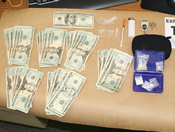
Photo courtesy of Ofc. Pete Steen, BHP/AST
Alaska Drug Evaluation and Classification Program
The Drug Evaluation and Classification (DEC)/Drug Recognition Expert (DRE) program is an international program intended to equip law enforcement officers with the knowledge and skills required to distinguish between impairment caused by drugs other than alcohol and impairment caused by other reasons. Furthermore, through a process of standardized and systematic observations and measurements, the Drug Recognition Expert (DRE) can classify the drug impairment as being characteristic of one or more classes of drugs. |
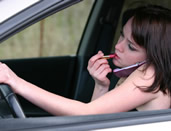
A teen driver applies make-up and talks while driving
Distracted Driving
States Increasing Efforts on Distracted Driving. Distracted driving has emerged as a priority for state highway safety agencies. Twenty-seven states, D.C., and Guam indicated that distracted driving is included in their Strategic Highway Safety Plans (SHSPs). |
Photo courtesy of the Alaska State Troopers.
Fatality Analysis Reporting System (FARS)
Since 1975, the National Highway Traffic Safety Administration (NHTSA) has operated and maintained the Fatality Analysis Reporting System (FARS). FARS is a national data collection system that contains information on all known motor vehicle traffic crashes in which there was at least one fatality.
|
Juneau PD Officer Blain Hatch
working with school children.
Photo courtesy of Officer Blain Hatch, Juneau PD.
Law Enforcement Liaison (LEL)
The Alaska Highway Safety Office and the National Highway Traffic Safety Administration Pacific Northwest Office work with the Juneau, Fairbanks, Wasilla and Kenai Police Departments to foster Alaska's Law Enforcement Liaison (LEL) program. Trained LEL Officers serve as a bridge of communication between the Highway Safety Office and state and local law enforcement agencies focusing on traffic safety, education, and law enforcement. |
Low Speed Vehicles
The National Highway Traffic Safety Administration (NHTSA) first adopted regulatory standards for low speed vehicles in 1998. The NHTSA regulations define a low speed vehicle (LSV) as a motor vehicle that (1) has four wheels; (2) can attain a speed in one mile on a paved, level surface of at least 20 miles per hour and not more than 25 miles per hour; and (3) has a gross vehicle weight rating of less than 3,000 pounds (49 CFR Sec. 571.3). The regulations do not limit LSVs to being electrically-powered. |
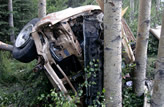
Crash Scene of the Juneau Mock Crash,
2010. Photo by Joanna Reed, DOT&PF
Mock Crash
Teen drivers may exhibit risky behavior such as consuming alcohol and/or drugs prior to, or while, driving a motor vehicle. The events and visual effects of Mock Crash productions provide an intense impact on these young adults, which will hopefully aid them in understanding the consequences of destructive behaviors such as driving while under the influence of alcohol and/or drugs. |
Bull moose crossing road near Denali National Park.
Photo by John Love, Alaska DOT&PF.
Moose Safety
Every year moose routinely cause injury-related traffic crashes throughout the interior of Alaska, resulting in millions of dollars in medical
bills and property damage. While moose are happy to
pose for a picture or two it is important to
give them lots of room, especially when calves
are nearby. |
Motorcycle Safety
Alaska, like other states in the nation, is experiencing an increase in the number of crashes involving motorcycles and subsequently an increase in motorcycle fatalities. The number of national motorcycle fatalities last year is more than double that of a decade ago. |
Changing old child protection seats for new at the 1st AK Child Passenger Safety Conference in Anchorage, celebrating Booster Seat Awareness Week, 2008. Photo by Gordon Glaser.
Occupant Protection
Information on correct seat belt use, agencies involved with protection of occupants and children in auto crashes, and answers to questions about seat belts in school busses. |
Fairbanks M&O workers replace a damaged traffic signal pole on the Mitchell Expressway in Fairbanks. Photo by Daniel Schacher, Alaska DOT&PF.
Red Light Running
In 2006, as many as 245 crashes, 190 injuries
and 2 fatalities in Alaska were attributed to red light
running. Between 2000 and 2006, motor crashes at traffic
signals increased 30.3 percent, outpacing the rise in
many other crashes in Alaska. Nationally Public costs
for Red Light Running crashes exceed $14 billion per
year. In Alaska and across the nation more than half
of the deaths in red light running crashes are other
motorists and pedestrians. |
Alaska's Walk to School program at Scenic Park Elementary School in Anchorage. Photo by Jerrianne Lowther
Safe Communities Program
The U.S. Department of Transportation has made a clear commitment to the philosophy that communities are in the best position to affect improvements in motor vehicle and other transportation-related safety problems. We know that when a community takes ownership of an issue, change happens! |
Alaska State Troopers make a DUI Arrest. Photo courtesy of the Alaska State Troopers.
DUI Information & Impaired Driving
Sections on:
DUI Driver Information
and
Impaired Driving Program
|
|
Safety Corridors & Maps
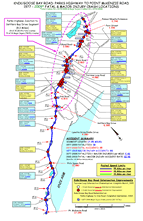
A designated Safety Corridor is a segment of a state highway that has been identified as having a higher than average incidence of fatal and serious injury crashes, and the Commissioners of Transportation & Public Facilities and Public Safety have agreed to provide funding for effective education, enforcement, engineers, and support emergency response agencies for those sections of road.
|
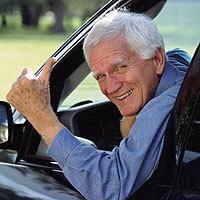
A man poses for a NHTSA driving ad
Senior Driving in Alaska
Everyone ages differently and where some
people are perfectly capable of continuing to drive
in their seventies, eighties, and even beyond; many
elders, however, are at higher risk for on or off road
crashes. According to studies conducted by the National
Highway Traffic Safety Administration (NHTSA) senior
drivers are more likely to receive traffic citations
for failing to yield, turning improperly, and running
red lights and stop signs - an indication of decreased
driving ability. |
Colony High School Students pose at the Muir Woods
National Monument. Photo Courtesy of Colony High School.
Teen Driving in Alaska
Every year teens account for approximately 20% of the fatalities and major injuries that occur on Alaska's roads and highways. Nearly half of these deaths can usually be prevented by simply buckling-up or not drinking and driving. Information for teens and parents on driving safely. |
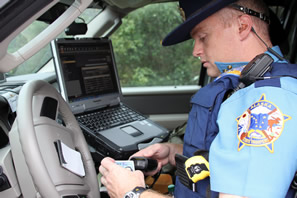
Scanning a Driver's License to auto-populate to a computer form. Photo courtesy of the Alaska State Troopers.
Traffic Records Program
Goals:
To improve
motor vehicle crash data in order to reduce crashes
and injuries on Alaska's roadways.
Ensure that complete, accurate and timely
traffic safety data are collected, analyzed and made
available for decision-making at the national, state
and local levels to reduce crashes, deaths and injuries
on our nation’s roadways.
|
|
|
|
|